
Flood Risk & Drainage
The Environment Agency (EA) Flood Map for Planning demonstrates the site to be located within Flood Zone 1 (areas deemed to possess a very low chance of fluvial flooding). The mapping also demonstrates the site to predominantly possess a very low chance of flooding from surface water (pluvial). This is with the exception of linear bands of surface water flood risk, which are mapped for all return periods, on land adjacent to the Draytonmead Brook, and on land adjacent to the existing field drains within the western extents of the site. All built development is to be offset from areas mapped to possess an annual likelihood of surface water flooding.
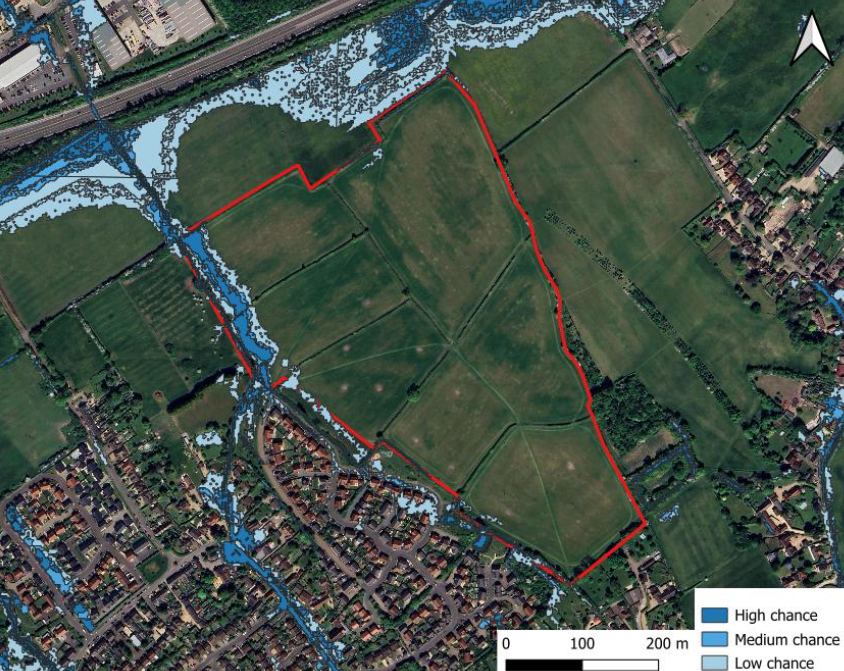
A desktop ground investigation demonstrates the site to be underlain by a sedimentary bedrock comprising of mudstone, siltstone and sandstone, and as such the use of infiltration drainage devices is deemed to be unfeasible. The Draytonmead Brook flows in a north-westerly direction adjacent to the site’s western boundary, the brook is designated as a ‘Main River’ by the EA and ultimately discharges into the River Thame in the north. The Draytonmead Brook is an ideal outfall location for surface water runoff produced onsite.
Runoff will be discharged at the existing greenfield runoff rate into the Draytonmead Brook as to mimic existing runoff conditions and to ensure that flood risk is not increased elsewhere as a result of the development. To achieve this surface water attenuation will be required, the primary attenuation for surface water produced onsite will be delivered by a wet pond. Additional sustainable drainage features are to also be incorporated within the development’s drainage design where feasible to enhance the treatment of surface water runoff produced onsite and to mitigate against pollution.